
In this post I talk about fitness, Reverse Pyramid and W-O-R-D-S.
Every few months, a new management book lands on bestseller lists, flooding X with fancy acronym-frameworks and LinkedIn with carousels like “The 5 habits of the most effective leaders.” And every time there is a spark of hope somewhere in the back of your mind: Could this be the solution to all problems?
It reminds me of Men’s Health. Every single issue, a new star on the cover, shredded and glowing. And inside it is always the same story: intense two-hour-long workouts twice a day, strict diet, years of consistency and discipline. No magic supplement or secret exercise, just healthy habits and relentless repetition (Lenny is 62, WTF?!)

Well, management is the same. I’ve read the books, taken the courses, built the frameworks, failed and succeeded, and here is what I learnt. Every time I trace a problem back to its root, it’s always the same thing at the core: communication. Someone just didn’t say something they should have or said it in a way that didn’t land.
Communication isn’t one of the tools in the manager’s toolkit. It’s the ground the toolkit sits on.
Agile, OKRs, retrospectives, 1:1s, RACI matrices – any of these tools can either work or collect dust in a Notion doc while the team keeps doing things their own way. Did the manager explain why this change matters, actually listen to the team’s pushback and create enough safety for people to say “this isn’t working”? If not, you probably end up in the second case where the new process falls short.
When I was working with the game board team in Tactile, we built a set of team principles and a retrospective format together. It worked, because we’d built it together — everyone understood why each piece was there. Later, moving to the remote Scrum team on Lily’s Garden, I thought I’d save everyone some time by bringing what we’d already figured out with the game board team. I introduced the same steps and the same format we used because why would I reinvent the wheel?
But it didn’t work as well as it was working for game board folks. Because the steps that had meant something for them were just words on a slide for the new team. We had to start from scratch, because people don’t learn from other teams’ mistakes and need to go through the process themselves to understand what sticks for this particular team, on this specific project.
The problem was not the framework but the assumption that it could be translated to another team without rebuilding the conversation around it.
You can follow the most optimized training program in the world but if you don’t understand why you’re doing each rep and don’t listen to what your body is telling you, you’ll plateau or get injured.
It all comes together from small pieces: the status update where you actually say “we have a problem” instead of burying it in good news, the “what do you think?” that you really mean, the check-in where you listen more than talk.
Clear communication is not a one-time fix, it should be a habit. And when I revise my older articles while cross-linking, I see I still have a lot to learn 😀 For instance, when I joined Playrix, I structured my written updates the way my legal background and years of blogging had trained me: context first, then the problem, then suggested actions. Logical, thorough, structured.
My COO read one and said: “These updates will be read by someone. Make it straight to the point and respect people’s time.”
That one line led me to the Inverted Pyramid – a journalistic principle that puts the most critical information first (the who, what, when, where, why, and how), with supporting details next and background last. The logic is that even if someone stops reading halfway, they already have what they need.
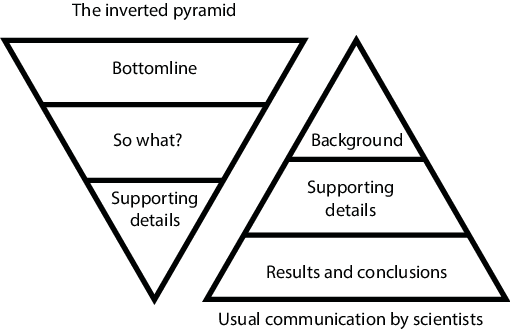
I’d been doing this instinctively in English as the most of my management work and studies happened in English, which leans toward direct communication. But in Russian, I was still writing in formal, structured, slow to the point language that court documents had trained me.
But that single conversation fixed it so I started to slowly build a conscious habit to develop a permanent change.
Communication is invisible when it works and you only notice it when it’s broken. There’s a formula in project management for counting communication channels in a team: n(n-1)/2. A team of 10 has 45 possible channels where a message can be lost. A team of 20 has 190 possible ways for a critical information to be posted at the wrong place for the wrong audience.
The fix is to make important info loud: the critical update goes into the tracker and the Slack channel and the next meeting and as a direct message to whoever needs to act on it. But make sure you don’t overuse it – otherwise it becomes noise and loses the feeling of urgency.
A few questions to return to regularly:
- When did I last hear actual pushback from my team and engage with it?
- Is the most important thing in my message also the most prominent one?
- Am I making enough space for the quieter people on the team to speak?
- When something goes wrong, do people come to me early?
If those answers make you uncomfortable, that’s the work.
And I will allow myself to also remind you my own W-O-R-D-S method:

W – “What do you mean”? Clarify when uncertain.
O – Objectivity is subjective. Your opinion is not the only right one.
R – Respect others. No matter how the conversation goes, keep yourself together.
D – Don’t assume. Ask questions – to double-check, to validate, to dig deeper.
S – Stop second-guessing. Don’t overthink this whole thing.
Showing up every day and doing the unsexy reps is what grants you the body of your dreams. The team culture you want works the same way – there is no secret, just talk.
Fun fact: the reverse pyramid exists in fitness too. I wonder if Kravitz uses it...
 Retrieving Thoughts