
A friend of mine from Copenhagen lost his job in November last year and has been searching for a developer role since then. Every time we talk, it always goes down to how weird the recruiting scene is recently. The thing that caught my eye is that he has to find a smooth way to explain why he left instead of saying bluntly that his former workplace was not very ethical with the ways they ran business (which is confirmed by other reviews on Glassdoor so it’s not just his subjective view). I’ve discussed this with several people, including the recruiters I work or have worked with, and here are some thoughts retrieved for you 🐶

I’ve been through many job interviews, both as the one sweating under the spotlight and the one asking questions. One thing that stands out as an odd programmed behavior is how we handle reputation. As a candidate, you’re drilled to never ever speak ill of your previous employer, no matter how chaotic or unfair things got. Say something negative and you’re labeled toxic and unprofessional. But flip the script to the reference check, and that same former boss can unload all sorts of criticism about you, your skills, or even your personality, with little to no fact checking. So the candidate bites their tongue while former boss bites back.
This asymmetry isn’t just annoying but also a reflection of power dynamics in the professional world.
Why Candidates Can’t Speak Up
Picture this: you’re in an interview and the recruiter asks that classic question: “Why did you leave your last workplace?” You know the drill – keep it positive, focus on growth opportunities or mutual parting ways. Even if your old boss was a micromanaging nightmare who turned team meetings into therapy sessions, you smile and say: “I was ready for new challenges.” Why? Because hiring manager is wired to spot red flags and any hint of negativity can lead to the assumption that the problem is you, not the environment.
I’ve been guilty of this bias myself back at Tactile. A talented developer once joined our team after a rocky exit from his previous studio – many people laid off in one day for a vague reason and with poor compensation, a pretty loud case in a small Danish industry. During his interview, he was all professionalism, highlighting what he learned rather than venting frustrations. And I thought then — had he slipped up, we might have passed, fearing drama.
Just search the web for “candidates who criticize past employers” and see how many pages will be citing the same. Several studies show the same number: such behavior will divert about 30% recruiters.

We’re expected to protect the company’s reputation, even after we’ve left, because our words reflect on us more than on them. And here I go again with my doggo references – Hunter barks at every passerby and has a reputation of angry dog, no matter if the stranger was a sketchy Wolt courier 🤨 But if I, as the owner, warn others about his quirks, it’s a helpful info. Candidates are the ones who have to stay composed, while employers get to be candid.
The Unchecked Power of References
During a background check, I as your former employer can say pretty much whatever as long as it’s not outright defamatory or discriminatory. Just phrasing it politely does the trick: “struggled with deadlines”, “not a team player”, “is not open to new approaches and tools”. Because the power imbalance favors the reference-giver, who is seen as the authority, providing objective insights. Actually, this works also with your former colleagues who are contacted to give you a reference. Funny enough, you are often asked for a contact to provide reference. And you can ask them to say whatever you want, the game is rigged 🤷♂️
Rarely does anyone question if the referee is biased – maybe they didn’t like your style or there is a grudge from your exit. I know CEOs of smaller startups who treat resignation as a betrayal and no one regulates what an ex-boss says in a private call with your hiring manager.
It’s like online reviews: customers can slam a product with one-star rants, but the seller has to respond diplomatically or risk looking worse.
The clickbait “double standard” boils down to risk. Companies want to minimize hiring mistakes, so they prioritize unfiltered input from references. Candidates, meanwhile, are “selling” themselves and negativity hurts the brand.
But this setup breeds resentment and can even discourage people from leaving bad situations. What if we tweaked it? Encourage structured reference forms that focus on facts over opinions – skills demonstrated, achievements, areas for growth (like retrospective format, basically). Or combine reference for a candidate with Glassdoor reviews of the company. Some of my former colleagues-recruiters do fact-check references and use specifically designed surveys to filter the feedback which helps to tip the scale.
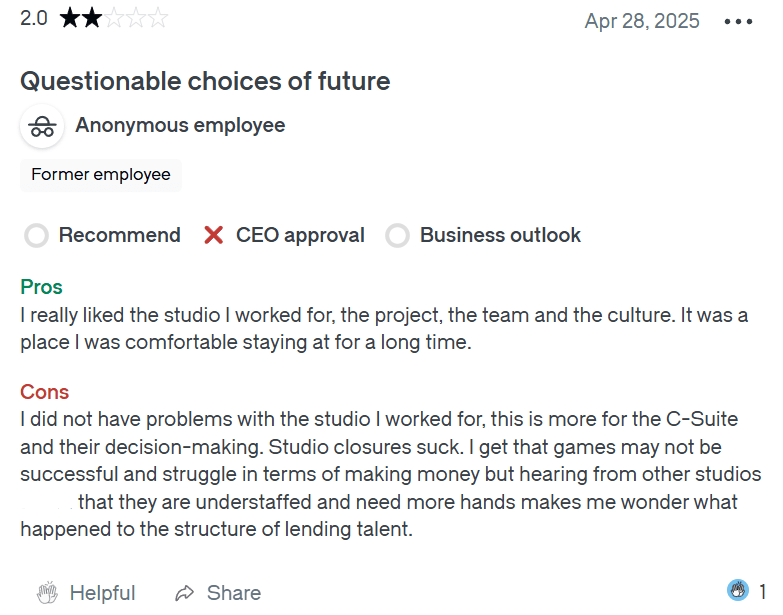
In game dev, we iterate on processes until they’re well-balanced and recruitment should be no different. Being aware of asymmetry helps us navigate it better – as candidate, frame your story right; as hirer, dig deeper into references without taking them as a single source of truth.
Next time you’re in an interview or checking refs, remember that a reputation is a two-way street, but right now, one lane has way more potholes. What do you think – is it a fair game or foul play?
 Retrieving Thoughts